
Author: Dr. Mustajab Haider Bukhari (PT), Founder, Cure on Call | Faisalabad, Pakistan Last reviewed: June 2026
Quick answer: Most nerve pain from a blood draw is mild and settles on its own. In the first day or two, rest the arm, avoid anything that reproduces the electric or shooting sensation, use a cold pack early then gentle warmth, and keep the arm moving gently rather than holding it still. Plain over-the-counter pain relief can help. See a doctor promptly if you have weakness, numbness that is spreading, pain that worsens after 48 to 72 hours, or burning pain that feels far out of proportion to a needle.
A blood test should take thirty seconds and leave nothing behind but a small bruise. When a needle catches a nerve, it leaves something else: a shooting or electric sensation down the forearm, tingling into the fingers, or an ache that keeps going long after the needle is out.
It is unsettling, mostly because the procedure felt so minor. The reassuring part is that this kind of injury usually recovers, and recovers faster when you handle the first week well. Here is how to tell what you are dealing with, what to do about it, and the point at which waiting becomes the wrong move.
First, is it actually nerve pain or just a sore arm?
This is the question that decides everything else, because ordinary soreness needs nothing and nerve irritation needs attention.
| Normal post-draw soreness | Likely nerve irritation | |
|---|---|---|
| Where it is | At the puncture site only | Travels down the forearm, into the wrist, hand, or fingers |
| What it feels like | Dull ache, tenderness, a bruise | Electric shock, shooting, burning, or pins and needles |
| When it starts | During or right after, fades steadily | A sharp zap during the draw, or a delayed ache building over hours |
| How it changes | Better within 24 to 48 hours | Lingers for days, or gets worse rather than better |
| Other signs | None | Numbness, weakness, trouble with fine movements like buttons or a pen |
If your symptoms sit firmly in the right-hand column, treat it as nerve irritation. One detail worth knowing: nerve symptoms do not always appear immediately. The classic description in the medical literature is a burning, shooting, or electrical pain that begins while the needle is still in place, or comes on several hours later. A delayed start does not make it less real.
What happened in your arm
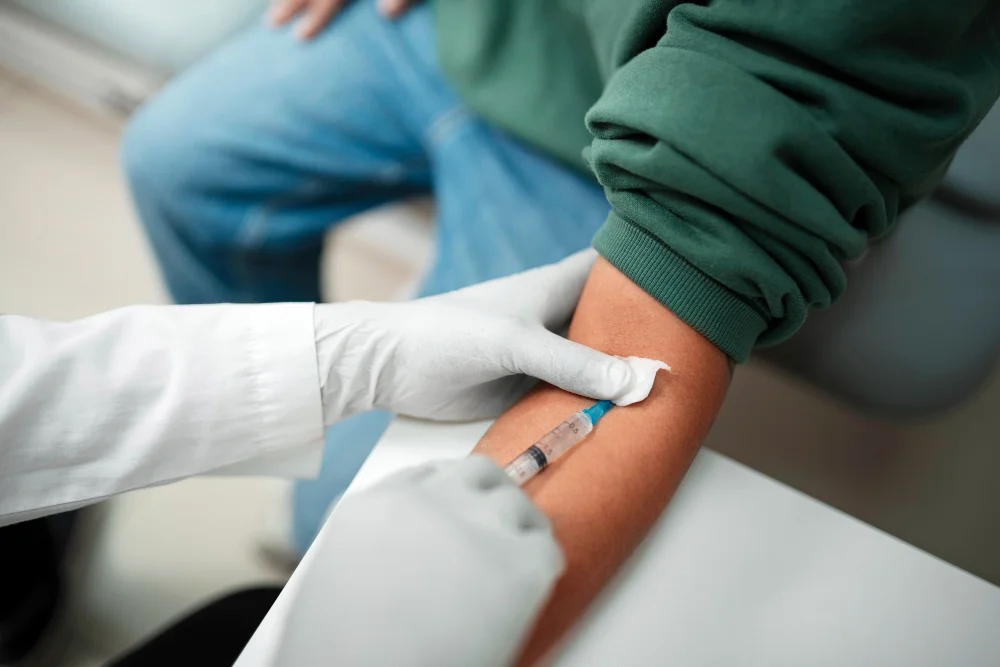
Blood is usually taken from the antecubital fossa, the soft hollow on the inside of your elbow. Several small nerves run close to the veins there, sometimes only millimetres away, so the two can sit closer than anyone would like even with careful technique. The nerve most often involved is the lateral antebrachial cutaneous nerve, a sensory branch supplying the outer forearm. The median nerve, deeper in the same region, is involved less often but matters more when it is.
There are two ways the injury tends to happen, and they feel different.
The first is direct contact. The needle grazes or nicks the nerve on the way in or out, and you feel that unmistakable zap in the moment. The second is slower. A hematoma, an internal bruise, presses on the nerve as it expands over the next few hours, so the pain builds quietly rather than arriving all at once. The slow kind is easy to dismiss because nothing dramatic happened during the draw itself.
For the record, this is genuinely uncommon. Estimates put nerve injury at somewhere around 1 in 20,000 to 1 in 25,000 routine blood draws. Blood donation, which uses a larger needle, carries a somewhat higher risk. Rare is not the same as never, but it does mean the odds are heavily on your side.
What to do in the first 48 hours
The early days set the tone for recovery. The aim is simple: calm the area, protect the nerve, and avoid the two mistakes people make, which are pushing through pain and freezing the arm completely.
Stop doing anything that reproduces the zap. This is the single most useful rule. Movement within a comfortable range helps. Movement that triggers the electric sensation does not, and repeating it can irritate a nerve that is trying to settle.
Cold first, then gentle warmth. For roughly the first 24 hours, a cold pack wrapped in cloth, never straight on the skin, for 10 to 15 minutes at a time helps quiet the inflammation around the nerve. After that, switch to gentle warmth to encourage blood flow to the area, which nerve tissue needs to heal.
Keep the arm moving, just gently. The instinct is to hold it dead still. Resist that. Light, pain-free use, opening doors, writing, lifting small things, keeps the nerve mobile and the circulation going. What to skip in this window is heavy lifting, repetitive gripping, and stretched positions at the inner elbow.
Elevate if there is swelling. If a bruise is forming, resting the arm propped up on a pillow, supported from elbow to wrist, helps drainage and eases pressure on the nerve.
Pain relief, used sensibly. A standard over-the-counter painkiller taken as directed can take the edge off. Two honest caveats. Do not lean on it for more than a few days without advice, and never use it to mask a symptom that is clearly escalating. If the pain needs medicating past a week, that is a reason to get assessed, not to keep dosing.
People often ask about B-vitamins for nerve repair. There is some interest in B12 for nerve health, but the evidence for it speeding recovery from this specific injury is limited, and it is not a substitute for the steps above. If you suspect you are deficient, raise it with your doctor rather than treating supplements as a fix.
When physiotherapy changes the outcome
If symptoms are still there past a week to ten days, or they are worsening instead of slowly easing, this is where hands-on rehab earns its place. As a physiotherapist, this is the stage where I see the difference between a nerve that settles cleanly and one that drags on because the arm was either overprotected or overused.
The most useful active tool is neural mobilization, sometimes called nerve gliding or flossing. These are controlled, specific movements that let the nerve slide freely within its tissue channel again, which reduces pressure on it and restores normal signalling. The key word is specific. A post-draw injury needs the lateral or medial antebrachial cutaneous nerve targeted directly, not a generic shoulder-and-arm routine pulled off a chart.
Hands-on soft tissue work helps where scar tissue or reactive tightness has started to grip the healing nerve, releasing it before that becomes a longer-term adhesion. Heat-based modalities can be a reasonable adjunct for comfort and circulation, though they support the active work rather than replace it.
This is the part of recovery that benefits most from being individualised. If you want a structured plan, our nerve pain physiotherapy team can assess which nerve is involved and build the right progression for your stage, either through online physiotherapy across Pakistan or a home visit in Faisalabad.
How long it takes to heal
This is what everyone actually wants to know, and the data here is genuinely encouraging.
In one review of venipuncture nerve injuries, roughly 70 percent resolved within one month, 90 percent within three months, and 96 percent within six months. In plainer terms, the large majority of people are fully better within weeks, and the great majority of the rest within half a year.
Mapped to severity:
- A brief graze or light touch often clears within a few days to two weeks with good home care.
- An injury with a hematoma pressing on the nerve is more in the four to eight week range, and physiotherapy in weeks two and three tends to shorten it.
- A direct injury with persistent burning, hypersensitivity, or weakness can take several months and is the group that benefits most from early, structured care.
The thread running through all of it: early recognition and sensible early management lift the outcome. A large prospective study at Japanese Red Cross centres found that catching and addressing these symptoms early reduced the chance of acute nerve pain turning chronic. The faster you respond, the better the ceiling on your recovery.
Red flags: when to see a doctor now
Most of the time this settles with patience. Occasionally it does not, and a few symptoms mean you should be assessed rather than wait:
- Weakness in the hand or arm: trouble gripping, dropping things, or difficulty straightening the fingers.
- Pain that is worse after 48 to 72 hours despite doing the right things.
- Numbness in part of the hand or fingers that is not improving, or is spreading.
- Swelling at or above the site that is growing rather than shrinking.
- Fever, spreading redness, or discharge, which point to infection rather than nerve injury and need prompt care.
There is one pattern that deserves its own mention, because it is rare but important to catch early. If the pain becomes burning and far out of proportion to a needle prick, and the limb develops changes like swelling, shifts in skin colour or temperature, sweating, or such sensitivity that light touch or clothing hurts, that can signal complex regional pain syndrome (CRPS). It typically sets in within the first few weeks after the trigger. CRPS is uncommon and the inciting event can seem trivial, which is exactly why it gets missed. It responds best to early, multidisciplinary treatment and referral to a pain specialist, so flag these symptoms quickly rather than enduring them.
You almost certainly will not reach this point. Acting early is what keeps it that way.
How doctors diagnose and treat the stubborn cases
If pain persists, a clinician will usually start with a hands-on exam of sensation, reflexes, and grip strength. When more detail is needed, the common tests are a nerve conduction study and EMG, which measure how well the nerve is carrying signals and whether muscle has been affected, and sometimes an ultrasound or MRI to check for a hematoma pressing on the nerve.
For cases that do not settle on their own, options include medications aimed specifically at nerve pain, TENS, targeted physiotherapy, and, in more severe or persistent cases, interventional pain management such as nerve blocks. The reassuring headline from the case literature is that most of these injuries improve over the following months, and prompt recognition gives an excellent prognosis. Surgery is rarely needed.
Lowering the risk next time
You cannot control someone else’s technique, but a few things genuinely help:
- Tell the phlebotomist before they start if you have had nerve pain from a draw before. Good practitioners adjust their vein choice and angle accordingly.
- Speak up immediately if you feel a sharp electric or shooting pain during the draw. That sensation is the cue for them to stop and reposition, and standard practice is to do exactly that.
- Keep the arm relaxed rather than clenched, and stay still while the needle is in. A sudden jerk with the needle in place can drag it across a nerve.
- If you have had trouble before, it is reasonable to ask them to consider a different vein in the area.
FAQs
The giveaway is the quality and path of the pain. A nerve hit usually produces a sharp, electric, or shooting sensation, often with tingling or numbness that travels down the forearm or into the fingers, rather than a dull ache confined to the puncture site. It can start the instant the needle goes in, or build over a few hours if a bruise is pressing on the nerve.
For most people, a few days to two weeks. In a published review, about 70 percent of these injuries resolved within a month and 90 percent within three months, with 96 percent settled by six months. Milder symptoms clear fastest.
Usually, yes. The large majority of cases settle with conservative care and time. The ones that need more help are those with weakness, spreading numbness, or pain that keeps worsening, which is why those specific symptoms are worth a prompt check rather than waiting.
Permanent damage is rare. Most injuries are temporary sensory irritation that recovers. A small minority involve persistent neuropathic pain or, rarely, CRPS, and these need early specialist input. Acting quickly when symptoms are escalating is the best protection against a lasting problem.
Keep using it gently. Holding the arm rigidly still can actually slow recovery. The aim is comfortable, pain-free movement while avoiding anything that triggers the electric sensation or involves heavy lifting and repetitive gripping in the first few days.
Mild, improving tingling over a few days can be part of normal nerve recovery. Tingling that is steady, spreading, or getting worse, or that comes with numbness or weakness, is the version that warrants an assessment.
Nerve pain from a blood draw feels alarming precisely because the cause was so small. But the trajectory is mostly in your favour: protect the arm, keep it gently moving, watch for the handful of red flags, and most of these settle within weeks. The cases that turn difficult are usually the ones left too long.
If you are days or weeks past a draw and the pain has not eased, that is worth a proper look rather than more waiting. Book a physiotherapy assessment with Cure on Call and we will work out which nerve is involved and what your arm actually needs to recover. You can also run your symptoms through our free pain checker to get a sense of urgency first.
Medical disclaimer: This article is for general information and does not replace a personal medical assessment. If you have severe pain, weakness, spreading numbness, signs of infection, or symptoms suggesting CRPS, seek care from a qualified healthcare professional promptly.
References
- Venipuncture-related lateral antebrachial cutaneous nerve injury. ScienceDirect. https://www.sciencedirect.com/science/article/pii/S0104001413001371
- Venipuncture-induced complex regional pain syndrome: a case report and review. NCBI / PMC. https://www.ncbi.nlm.nih.gov/pmc/articles/PMC4156992/
- Screening test and education reduce chronic pain after blood donation (Japanese Red Cross). NCBI / PMC. https://www.ncbi.nlm.nih.gov/pmc/articles/PMC11813037/
- Venipuncture-related median nerve palsy. Case Reports in Neurology, Karger. https://karger.com/crn/article/13/2/361/821034/Venipuncture-Related-Median-Nerve-Palsy-Disguised
- Nerve damage after blood draw: symptoms and prevention. myOnsite Healthcare. https://myonsitehealthcare.com/blog/symptoms-and-prevention-of-nerve-damage-blood-draw/
Book a consultation with Cureoncall today and let our home physiotherapy team guide your recovery, step by step.
Read Also: How to Treat Green Nails at Home?
Read Also: What’s the Best Time to Apply Vaseline Lip Therapy?
Read Also: How to Stop Facial Hair Growth Due to PCOS Naturally

Dr. Mustajab Haider Bukhari (PT) is the Founder and Owner of Cure On Call and a qualified physiotherapist based in Faisalabad, Pakistan. He specialises in musculoskeletal rehabilitation, chronic pain management, and post-injury recovery through evidence-based physiotherapy. Dr. Bukhari has extensive experience providing patient-centred care through in-clinic and home-based physiotherapy services. Under his leadership, Cure On Call integrates physiotherapy with nutrition and remote care to deliver holistic, accessible healthcare solutions.