Answer first:
If you want a 7-day rice diet plan that’s realistic, safer, and more likely to support fat loss than the “rice-only” versions online, do this:
- Eat rice once or twice a day, not at every meal.
- Keep your rice portion to ~150g cooked per rice meal (about 2–3 heaped tablespoons).
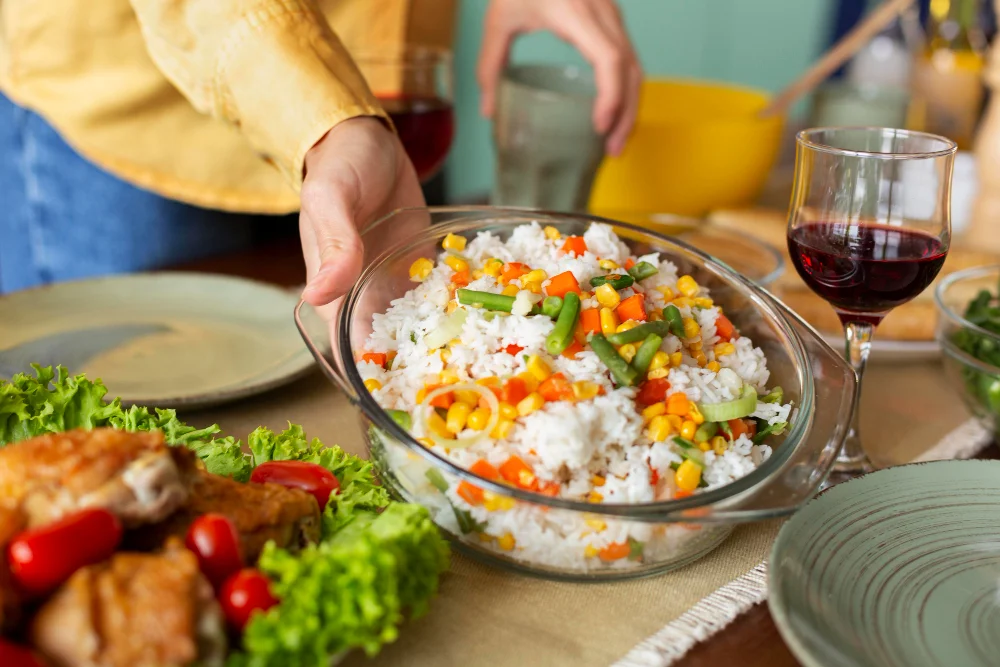
- Build each rice meal using the Plate Method:
- ¼ plate rice
- ¼ plate protein
- ½ plate vegetables
- 1–2 teaspoons healthy fat
- Food safety is non-negotiable with rice: cool fast, refrigerate promptly, use within 24 hours, reheat until steaming hot throughout.
That’s the entire strategy. The rest of this article makes it easy to execute for seven days—without rebound eating afterwards.
For personalised dietary guidance based on your health goals, lifestyle, and medical needs, you can consult a qualified professional through our online nutrition consultation services.
Why this works (and why most “rice diets” backfire)
Have you ever promised yourself you’ll “reset” for a week… then found yourself hungry by 4 pm, snacking at night, and finishing the week feeling more frustrated than proud?
Most “rice diets” fail because they treat rice as the whole diet. That usually means:
- too little protein (so you stay hungry)
- too little fibre (so appetite rebounds)
- too little variety (so cravings rise)
This plan keeps rice because it’s familiar and satisfying—but it uses rice as a carbohydrate anchor inside balanced meals. That’s far more aligned with mainstream healthy-eating guidance (e.g., the NHS Eatwell approach emphasises balance and wholegrain choices where possible).
Source: NHS Eatwell Guide.
Who this plan is for (and who should pause)
A good fit if you want:
- a simple, culturally flexible week
- a portion-based plan (no calorie counting required)
- meals built around rice, daal, sabzi, yoghurt/raita, fish, chicken, tofu, beans
Speak to a clinician first if you:
- have diabetes (rice can still fit, but timing and portions matter)
- are pregnant/breastfeeding
- have kidney disease, active GI disease, or a history of eating disorders
The Rice Plate Method (your rule for the whole week)
Use this at lunch and dinner:
- ¼ plate: cooked rice (start with ~150g cooked)
- ¼ plate: protein (one palm)
- ½ plate: vegetables (two fists)
- + 1–2 teaspoons: healthy fat
If you’re hungry: increase vegetables first, then protein. This keeps the plan sustainable and prevents the “I cut rice and now I’m starving” problem.
7-Day Rice Diet Plan (snippable schedule)
This is written for real life: simple breakfast, two rice-based main meals, and optional snacks.
| Day | Breakfast | Lunch (rice meal) | Dinner (rice meal) | Snack (optional) | Quick note |
|---|---|---|---|---|---|
| 1 | Greek yoghurt + oats + berries | Chicken (or chickpea) rice bowl + salad | Stir-fry veg + tofu/egg + rice | Fruit + nuts | Cook 3–4 rice portions |
| 2 | Eggs/tofu scramble + tomatoes | Lentil daal + rice + raita | Fish/tofu + roast veg + rice | Hummus + veg | Batch daal for 2 days |
| 3 | Overnight oats + chia | Tuna (or bean) rice salad | Chickpea-spinach stew + rice | Yoghurt | Chop crunchy veg box |
| 4 | High-protein breakfast | “Half rice, double veg” bowl + mince/lentils | Soup + small rice portion | Cottage cheese | Sauce on standby |
| 5 | Peanut butter toast + banana | Bean chilli + rice + salad | Egg fried rice (fresh + hot) | Orange | Use leftover veg |
| 6 | Protein-based breakfast | Eating out: rice + veg + protein | Simple home plate | Popcorn/yoghurt | Sauces on the side |
| 7 | Yoghurt bowl or eggs | Leftovers remix bowl | Transition meal + plan next week | Fruit | Avoid rebound |
Day-by-day details:
Day 1: steady energy
- Lunch idea: rice + chicken + cucumber + tomatoes + lemon + yoghurt sauce
- Dinner idea: stir-fry mixed veg + tofu/egg + rice
Tip: start the week with high satiety; it reduces late-night snacking.
Day 2: curry day (easy compliance)
- Lunch: daal + rice + raita/salad
- Dinner: grilled fish/chicken/tofu + roast veg + rice
Tip: measure oil once. “Free-pour” is the fastest way to accidentally turn a healthy curry into a calorie bomb.
Day 3: fibre and volume
- Lunch: rice salad (beans + veg + herbs + olive oil + vinegar)
- Dinner: chickpea + spinach stew + rice
Day 4: lower-GI tactics (without obsession)
If you’re prone to hunger spikes, try a practical swap: half rice, double vegetables at lunch.
If you want a lower-GI rice choice, basmati and brown rice are commonly suggested as lower-GI options compared with standard white rice in diabetes education materials. (If you have diabetes, personalise this with your clinician.)
Day 5: fried rice—done properly
- Make it fresh and serve piping hot.
- Don’t leave cooked rice sitting warm on the counter.
Day 6: eating out
Order rice-based meals that clearly include:
- a protein you can identify (chicken, fish, tofu, beans)
- vegetables (salad, stir-fry veg, soup)
- sauces on the side if they’re creamy/sugary
Day 7: transition day (the anti-rebound day)
The goal is not “perfect eating”. The goal is leaving the week with a repeatable routine:
- keep the plate method
- start rotating carbs next week (potatoes, wholegrain pasta, oats, legumes)
Portions (the part that decides results)
The simplest portion set-up
- Cooked rice: start with ~150g cooked (BDA reference already linked above)
- Protein: one palm
- Vegetables: two fists
- Fat: 1–2 teaspoons oil OR a small handful of nuts/seeds
If your rice portions are currently large
Don’t cut aggressively on day one. Use a smoother ramp:
- Days 1–2: keep rice similar, double vegetables
- Days 3–7: move towards the ~150g cooked portion target
Which rice is best?
There’s no magic rice. There is a better choice for your body and your routine.
- Brown rice: more fibre and micronutrients; can be more filling; sometimes heavier on digestion.
- White/basmati rice: easier to digest; works well if portions are sensible and meals are balanced.
- Parboiled rice: practical for meal prep.
Ranking-relevant truth: the best rice is the one you’ll eat consistently inside balanced meals.
Optional performance upgrade: cooled and reheated rice
If you like meal prep, there’s a potentially useful tool: cooking rice, cooling it, then reheating it safely. A controlled study in healthy adults found that cooled-and-reheated rice increased resistant starch and produced a lower glycaemic response than freshly cooked rice.
Source: PubMed study.
Important: only do this if you follow the rice safety rules (cool quickly, refrigerate, use within 24 hours, reheat steaming hot).
Food safety (rice is a common mistake)
This is where many meal plans quietly fail—not nutritionally, but practically.
Follow these rules (from the UK Food Standards Agency):
- Cool cooked rice quickly (ideally within about an hour).
- Refrigerate promptly.
- Use within 24 hours.
- Reheat until steaming hot throughout.
Source: FSA cooked rice safety (already linked above).
Arsenic in rice (what to do without panic)
Rice can contain arsenic. The most sensible approach is not fear—it’s variety.
Practical steps:
- Rotate grains across the week (rice, oats, potatoes, wholegrain pasta, quinoa, barley).
- If rice is a daily staple, consider varying types/brands and cooking methods.
Source: FSA arsenic in rice.
45-minute meal prep (Sunday reset)
- Cook 3–4 portions of rice (not 14).
- Batch one protein: chicken tray-bake, lentil daal, or tofu base.
- Prep crunchy veg: cucumber, carrots, peppers.
- Make one sauce: yoghurt + lemon + garlic.
Then you’re basically on autopilot.
Quick takeaways (what to do today)
- Choose your rice and set your default portion (~150g cooked).
- Add protein to every rice meal.
- Double veg before cutting rice aggressively.
- Store leftover rice safely.
- Rotate grains over time for variety.
FAQs
Is a 7-day rice diet good for weight loss?
It can be, if rice is portioned and paired with protein and vegetables so you maintain a modest calorie deficit without excessive hunger.
How much rice should I eat per day?
Most people do well with one to two rice meals per day, each with ~150g cooked rice, then adjust based on activity and hunger.
Can I eat white rice and still lose weight?
Yes. Weight loss depends mainly on overall intake and consistency. White rice can fit if portions are sensible and meals are balanced.
Is reheated rice safe?
Yes if stored correctly: cool quickly, refrigerate promptly, use within 24 hours, and reheat until steaming hot throughout.
How do I reduce arsenic exposure from rice?
Keep rice as part of a varied diet, rotate grains, and vary rice types/brands over time.
References:
- British Dietetic Association (BDA) – portion sizes
- NHS – Eatwell Guide
- Food Standards Agency (FSA) – cooking and reheating rice safely
- Food Standards Agency (FSA) – arsenic in rice
- PubMed – cooled/reheated rice and glycaemic response
Read Also: 7-Day Protein Diet Plan for Weight Loss
Read Also: 30 Day Chicken and Rice Diet: What Really Happens to Your Body?

DT Nimra Naqvi is an MPhil-qualified clinical nutritionist specialising in therapeutic, condition-specific nutrition care. She designs personalised nutrition plans for metabolic, hormonal, digestive, and recovery-related conditions, grounded in evidence-based practice. Her work focuses on integrating nutrition with medical treatment and rehabilitation to support sustainable health outcomes. DT Nimra Naqvi provides professional online consultations for international clients across the USA, UK, and Europe.