
Have you ever found yourself wondering whether speech therapy at home can actually work—or whether you might do more harm than good without a professional sitting beside you?
That question is far more common than most parents, caregivers, and even adults with speech difficulties like to admit. I remember the first time a parent asked me this during an informal consultation: “If I practise with my child every day, will that really help—or am I just guessing?” The honest answer is nuanced. Done randomly, home practice can be ineffective. Done correctly, it can be transformational.
Speech therapy at home is not about replacing a qualified speech and language therapist (SLT). It is about extending evidence‑based therapy into daily life, where communication actually happens. Research consistently shows that frequent, guided practice in natural environments accelerates progress, particularly for children with speech sound disorders, language delays, stammering, and even adults recovering from neurological conditions.
This article draws on clinical evidence, practitioner experience, and real‑world application to show you how to do speech therapy at home safely, effectively, and confidently—while knowing when professional input is essential.
What Is Speech Therapy—and Why Home Practice Matters
Speech and language therapy focuses on improving how a person communicates. That may involve:
- Speech sounds (articulation and phonology)
- Language skills (understanding and using words and sentences)
- Fluency (stammering)
- Voice (hoarseness, pitch, vocal strain)
- Social communication (pragmatics)
- Swallowing and feeding (dysphagia)
A landmark review in The Journal of Speech, Language, and Hearing Research reports that therapy intensity and consistency strongly predict outcomes—particularly for children. In simple terms: what happens between sessions matters just as much as what happens in the clinic.
Professor Pam Enderby, a respected UK speech and language therapy researcher, has repeatedly emphasised that caregiver‑led practice, when aligned with professional goals, significantly improves generalisation—the ability to use skills outside therapy rooms.
Who Can Benefit from Speech Therapy at Home?
Home‑based speech practice can support:
- Toddlers with delayed speech and language milestones
- Children with articulation or phonological disorders
- Children with autism or social communication difficulties
- Teenagers with residual speech sound errors
- Adults after stroke or brain injury
- Adults with voice or fluency difficulties
However, home therapy should always be guided by assessment. The Royal College of Speech and Language Therapists (RCSLT) clearly states that therapy without proper diagnosis risks reinforcing incorrect patterns.
Step One: Start with the Right Foundation (Assessment First)
Before practising anything at home, a qualified speech and language therapist should assess:
- What the difficulty actually is
- Why it is happening
- Which skills need targeting first
For example, I once worked with a child who substituted /t/ for /k/ (“tar” instead of “car”). The parents had been drilling /k/ sounds daily—with no improvement. The assessment revealed a phonological processing issue, not a simple articulation error. Once the approach changed, progress followed within weeks.
Key takeaway: practising the wrong thing, even enthusiastically, wastes time.
Step Two: Create a Speech‑Friendly Home Environment
Speech therapy at home does not require flashcards everywhere or rigid schedules. In fact, natural communication works best.
Make Communication Inevitable
- Pause before handing over items so the child needs to request
- Offer choices (“apple or banana?”) instead of yes/no questions
- Model correct speech naturally without demanding repetition
Reduce Pressure
Pressure increases anxiety, which directly interferes with speech motor planning and fluency. Keep sessions short, positive, and playful.
A practical rule used by many clinicians is “little and often”—5 to 15 minutes, once or twice daily.
Step Three: Evidence‑Based Home Techniques That Actually Work
1. Modelling and Expansion
Instead of correcting directly:
- Child: “Dog run.”
- Adult: “Yes, the dog is running fast!”
This technique is supported by multiple language development studies and is especially effective for toddlers and preschoolers.
2. Articulation Practice (When Recommended)
If a therapist has prescribed sound practice:
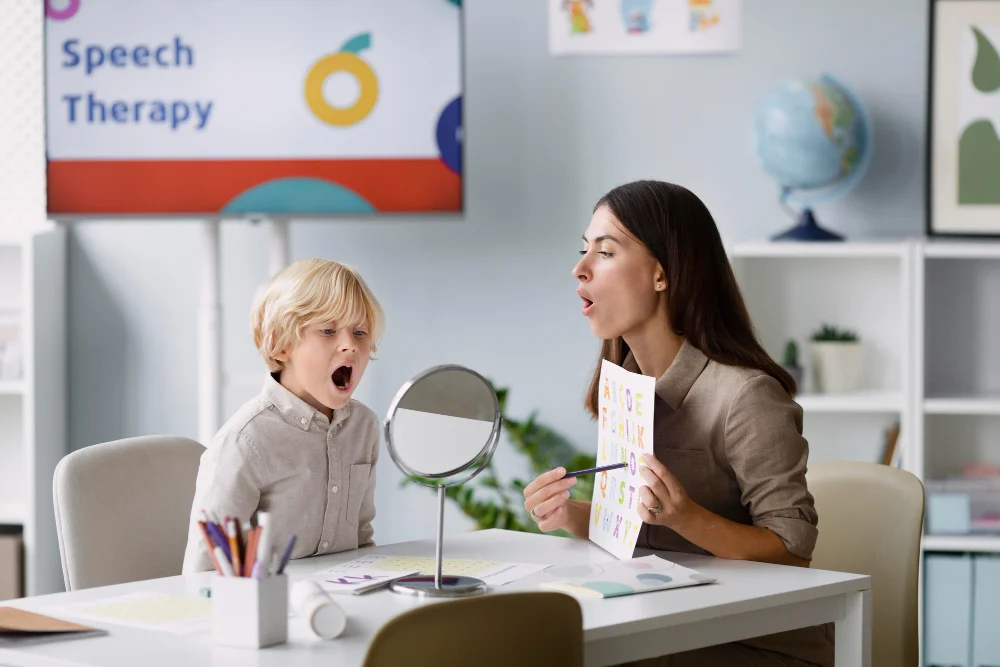
- Work in front of a mirror
- Start with single sounds, then syllables, then words
- Stop immediately if frustration appears
Clinical evidence shows that accuracy matters more than repetition. Ten correct productions are more valuable than fifty incorrect ones.
3. Play‑Based Therapy
Speech improves fastest during play. Board games, pretend play, and storybooks naturally elicit language without pressure.
Dr Caroline Bowen, an Australian speech‑language pathologist whose resources are widely cited in UK clinical practice, highlights that play‑based intervention leads to better long‑term retention than drill‑only methods.
4. Everyday Routines as Therapy
Meals, bath time, shopping, and bedtime stories are ideal therapy opportunities. Describe actions, name objects, and encourage turn‑taking.
Step Four: Supporting Fluency and Stammering at Home
If a child or adult stammers, do not attempt to “fix” the speech.
Evidence‑based strategies include:
- Slowing your own speech rate
- Maintaining eye contact and patience
- Avoiding interruptions or sentence‑finishing
The British Stammering Association notes that reduced communicative pressure alone can significantly reduce stammer severity in children.
Step Five: Voice and Pronunciation Care for Adults
Adults practising speech therapy at home—particularly for voice or post‑stroke rehabilitation—should focus on:
- Proper breath support
- Gentle voice use (no shouting or whispering)
- Consistent hydration
A 2021 review in The Lancet emphasised that guided home exercises significantly improve outcomes in neuro‑rehabilitation when combined with professional oversight.
Common Mistakes to Avoid
- Overcorrecting every error
- Turning therapy into punishment
- Practising without professional guidance
- Expecting instant results
Speech development is neurological and muscular—it changes gradually, not overnight.
When Home Therapy Is Not Enough
Seek professional input urgently if you notice:
- Regression in speech or language
- No improvement after consistent practice
- Feeding or swallowing difficulties
- Voice loss lasting more than three weeks
Early intervention is not a slogan—it is a clinical reality supported by decades of research.
Speech Therapy at Home with Professional Support: Cure On Call
While home practice is powerful, outcomes are strongest when guided by professionals. At Cure On Call, we provide structured speech therapy services, including personalised home programmes designed by qualified therapists. These programmes ensure that families and individuals practise the right skills, in the right way, with ongoing monitoring and adjustment.
This blended model—professional assessment plus guided home therapy—aligns with international best practice standards and maximises long‑term success.
Actionable Takeaways You Can Apply Today
- Book a professional speech and language assessment
- Practise little and often, not for long periods
- Embed therapy into daily routines
- Focus on quality, not quantity
- Keep communication enjoyable and pressure‑free
Frequently Asked Questions (FAQ)
Can speech therapy really be done at home?
Yes—when guided by a qualified therapist. Home practice enhances, but does not replace, professional care.
How long does speech therapy take to show results?
Some changes appear within weeks, while others take months. Progress depends on the condition, frequency, and accuracy of practice.
Can parents do speech therapy without training?
Parents can support therapy effectively after receiving professional guidance and goals.
Is speech delay always serious?
Not always—but persistent delays should never be ignored. Early assessment prevents long‑term difficulties.
Final Thoughts and Invitation
Speech therapy at home is not about perfection—it is about consistent, informed support. When families understand what to do and why they are doing it, communication changes naturally and confidently.
If you have tried home practice before, what worked—and what did not? Share your experience or questions below. Thoughtful discussion helps others take the first step with confidence.
Read Also: How to Do Chest Physiotherapy for Adults

Dr. Mustajab Haider Bukhari (PT) is the Founder and Owner of Cure On Call and a qualified physiotherapist based in Faisalabad, Pakistan. He specialises in musculoskeletal rehabilitation, chronic pain management, and post-injury recovery through evidence-based physiotherapy. Dr. Bukhari has extensive experience providing patient-centred care through in-clinic and home-based physiotherapy services. Under his leadership, Cure On Call integrates physiotherapy with nutrition and remote care to deliver holistic, accessible healthcare solutions.